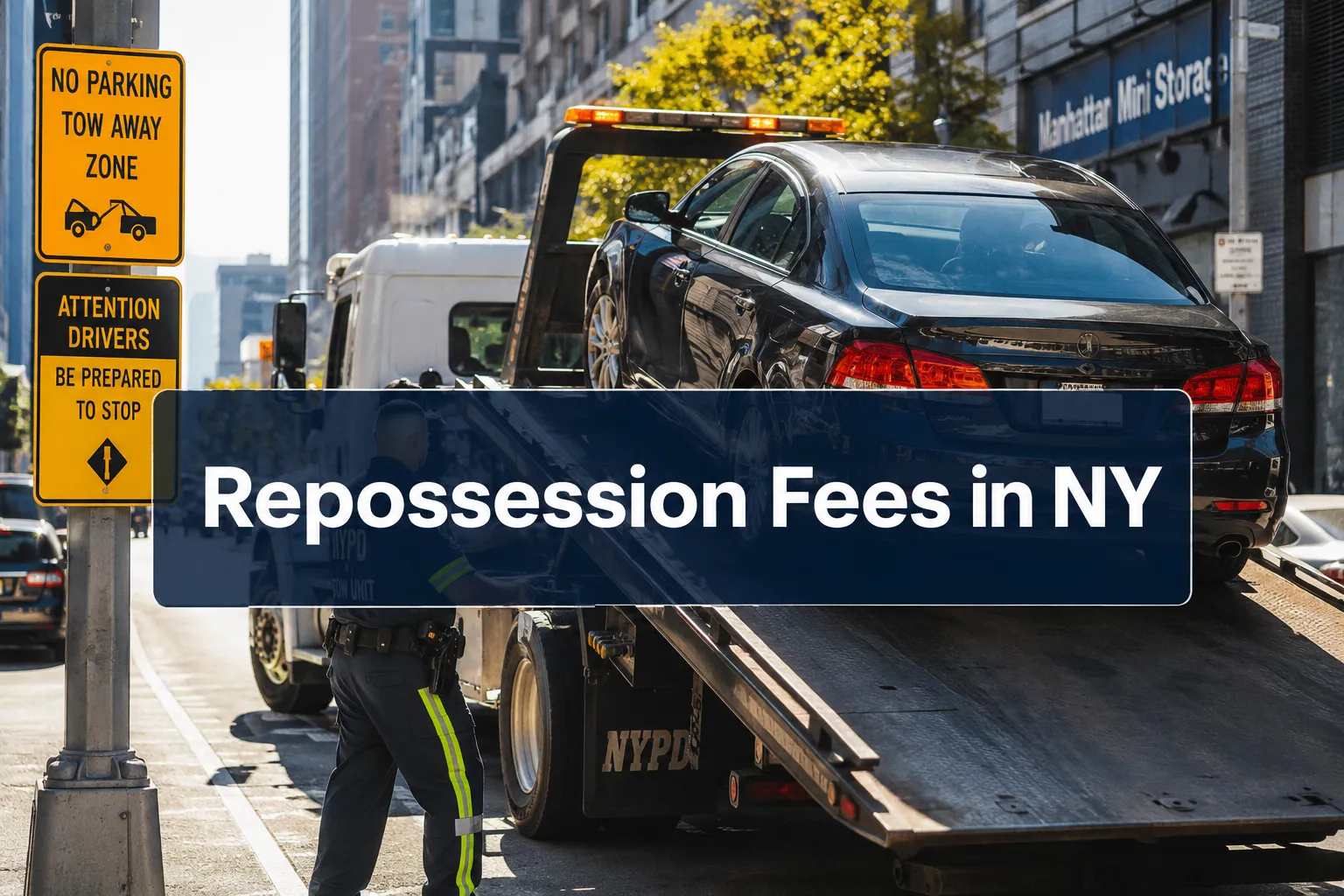
New York law does not cap repossession fees at a fixed dollar amount. Instead, lenders and repossession agents may charge you only «reasonable expenses» for taking, storing, and selling your vehicle, and those costs can climb quickly if you don’t act fast. Understanding how much are repossession fees in NY means knowing what charges are legal, what you must pay to redeem your car, and how to challenge unfair costs before they drain your wallet.
Repossession fees in New York typically include the agent’s pickup charge (often $200,$500), towing and transport, daily storage (commonly $25,$75 per day), administrative costs, and any legal or notice expenses the lender incurred [1][4]. Because storage accrues daily, a vehicle held for two weeks can accumulate $350,$1,050 in storage alone. This guide breaks down every component of how much are repossession fees in NY, explains your legal rights under New York’s Uniform Commercial Code, and shows you how to retrieve your vehicle or dispute excessive charges.
Key Takeaways
- New York law requires repossession fees to be «reasonable» but sets no fixed dollar cap; typical agent fees range $200,$500, plus towing and storage.
- Daily storage charges of $25,$75 accrue from the moment your car is impounded, making early redemption critical to avoid mounting costs.
- You have the right to redeem your vehicle by paying the full loan balance, all repossession expenses, and any accrued interest before the lender sells it.
- Lenders must send you a written notice listing the total redemption amount, including every fee, within a legally mandated timeframe.
- If fees appear excessive or undocumented, you can challenge them in court; New York’s UCC Article 9 requires all charges to be commercially reasonable.
What Are Repossession Fees in New York?
Repossession fees are the costs a lender passes to you after hiring an agent to seize, tow, store, and prepare your vehicle for sale. In New York, these fees must be «reasonable» under Article 9 of the Uniform Commercial Code [1][6]. The law does not publish a schedule of maximum charges; instead, courts evaluate whether each expense reflects actual, necessary costs incurred by the lender.
Common repossession-related charges include:
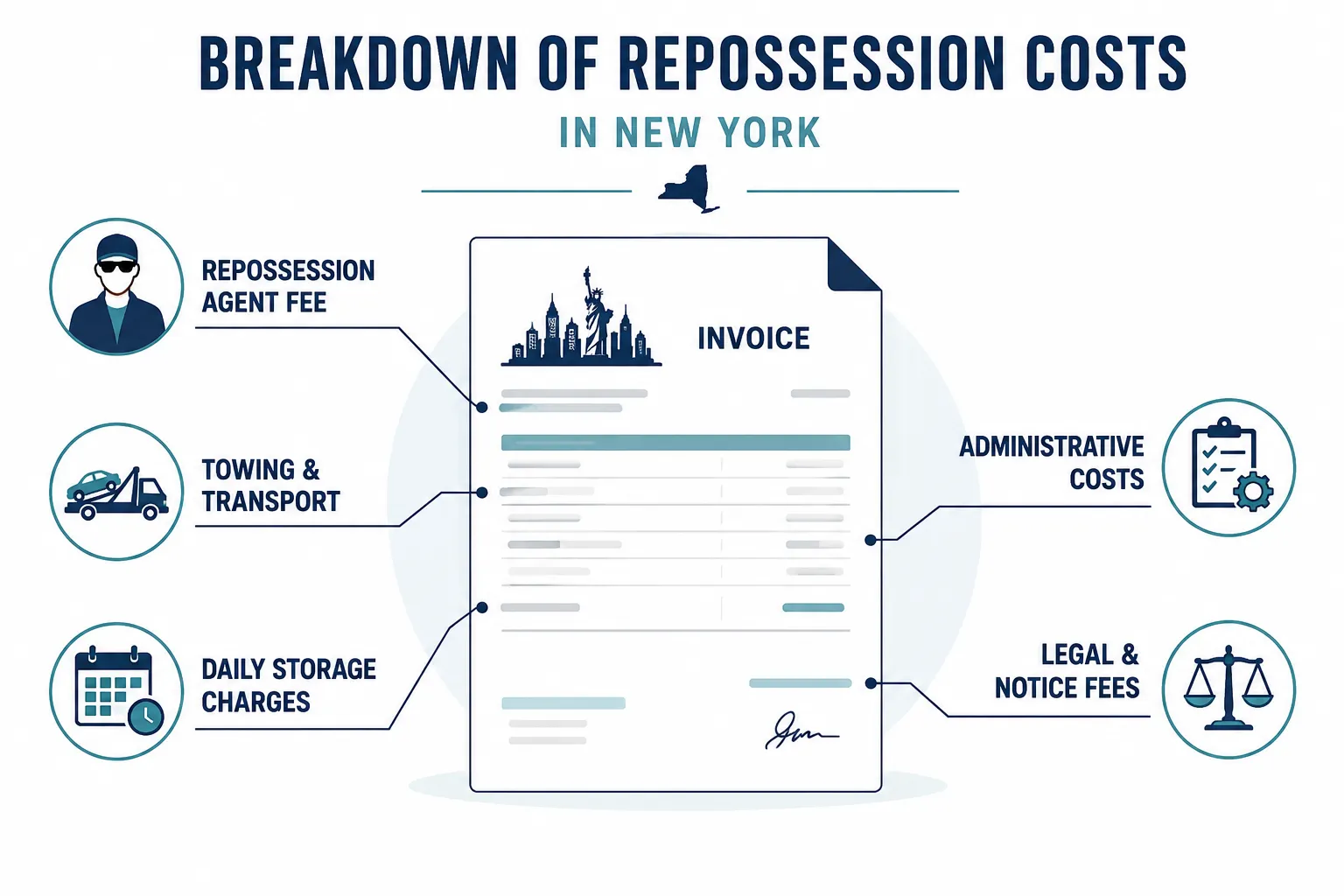
- Repossession agent fee: The flat charge for locating and taking possession of your vehicle, typically $200,$500 depending on the difficulty of the pickup [4][10].
- Towing and transport: The cost to haul your car from the street or driveway to the impound lot, often $100,$300 based on distance and vehicle size.
- Daily storage: A per-day fee for holding your vehicle in a secure facility, ranging $25,$75 per day [1][4]. Storage begins the day the car arrives and continues until you redeem it or the lender sells it.
- Administrative and processing costs: Paperwork, title searches, lien filings, and notice preparation, usually $50,$150 total [8].
- Legal and notice expenses: Certified mail, publication costs if required, and attorney fees if the lender obtained a court order (rare in voluntary-lien repos but possible in breach-of-peace disputes).
Because storage accrues daily, the total amount you owe grows every 24 hours your vehicle remains impounded. A car held for 10 days at $50/day adds $500 in storage alone, on top of the initial agent and towing fees.
How Much Are Repossession Fees in NY: Typical Cost Ranges
While New York does not mandate a fee schedule, industry practice and consumer reports reveal consistent ranges for how much are repossession fees in NY in 2026:
| Fee Component | Typical Range | Notes |
|---|---|---|
| Repossession agent pickup | $200,$500 | Higher for hard-to-locate vehicles or after-hours recovery |
| Towing and transport | $100,$300 | Distance, vehicle weight, and flatbed vs. wheel-lift affect cost |
| Daily storage | $25,$75/day | Begins immediately; can exceed $1,000 after two weeks |
| Administrative costs | $50,$150 | Title search, lien filing, notice preparation |
| Legal/notice expenses | $50,$200 | Certified mail, publication, attorney fees if litigation occurred |
Real-world example: A borrower in New York City whose sedan was repossessed and held for 14 days faced a redemption bill of $3,200: $400 agent fee, $250 towing, $700 storage (14 days × $50), $100 administrative, $75 certified-mail notices, plus $1,675 in past-due loan payments and interest [4]. The storage component alone accounted for nearly one-quarter of the total redemption cost.
Lenders often contract with repossession companies that charge the lender a wholesale rate, then the lender invoices you for the full retail amount plus markup [10]. New York law permits recovery of actual expenses but forbids padding fees beyond what the lender truly paid unless the charge reflects genuine administrative overhead [1][6].
What You Must Pay to Redeem Your Repossessed Vehicle
Under New York UCC § 9-623, you have an absolute right to redeem your vehicle at any time before the lender sells it [9]. To redeem, you must pay:
- The entire outstanding loan balance (not just past-due installments).
- All reasonable repossession expenses itemized by the lender.
- Accrued interest and late fees through the redemption date.
- Any attorney fees or court costs if specified in your loan contract and actually incurred.
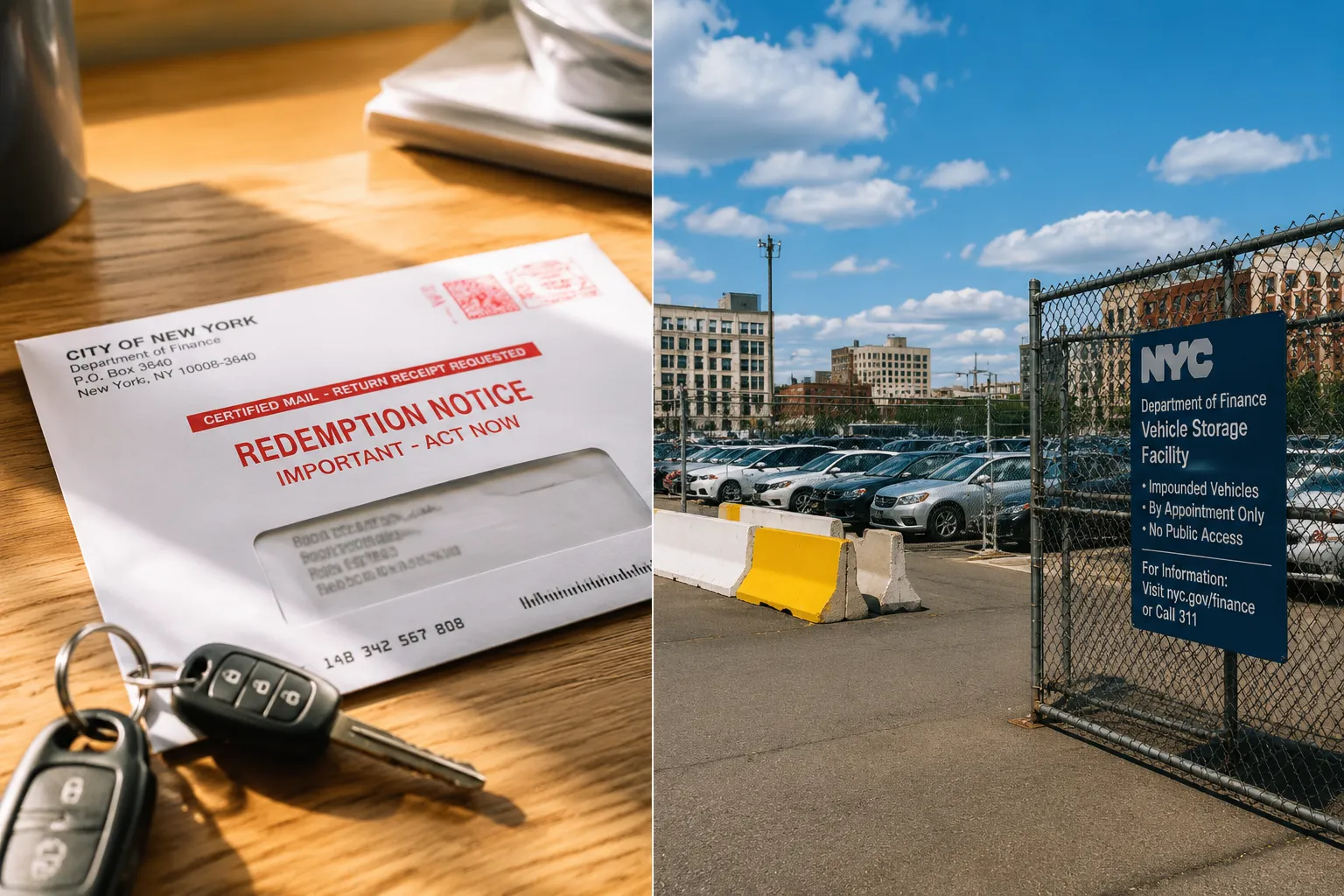
The lender must provide you with a written notice of redemption amount that lists every fee and the total sum required [8]. This notice typically arrives by certified mail within 5-10 business days of repossession. If the lender fails to send the notice or inflates charges, you may challenge the redemption figure in court before paying.
Key deadlines:
- You can redeem until the lender completes the sale (auction or private sale).
- Once the vehicle is sold, your redemption right expires; you can only pursue a deficiency-balance dispute if the sale proceeds fall short of your loan balance [2][4].
Paying the redemption amount in full immediately stops storage fees and returns your car. Many New York borrowers negotiate partial payment plans with lenders before the sale deadline, though lenders are not legally required to accept installment redemption [6].
If you cannot afford the full redemption cost, explore off-street parking options and garage rate comparisons to avoid additional Alternate Side Parking violations while you resolve the repossession.
How Repossession Fees Are Applied After Sale
If you do not redeem your vehicle, the lender will sell it at public auction or through a private sale. New York UCC § 9-615 governs how sale proceeds are distributed [1][6]:
- Reasonable expenses of repossession, storage, and sale are deducted first.
- The outstanding loan balance (principal, interest, late fees) is paid second.
- Any surplus goes to you or to junior lienholders (rare in auto repos).
- Any deficiency (shortfall) may be collected from you if your loan contract permits and the lender provides proper notice [2][4].
Example: Your loan balance is $8,000. Repossession and storage fees total $1,200. The lender sells your car for $6,500. The $1,200 in fees is paid first, leaving $5,300 to apply against your $8,000 balance. You still owe a $2,700 deficiency, which the lender can pursue through collections or lawsuit [4].
Lenders must conduct every sale in a «commercially reasonable» manner, adequate notice, fair market advertising, and a price reflecting actual market value [6][8]. If the sale was rushed, underpriced, or conducted without proper notice, you can challenge the deficiency in court and argue that inflated repossession fees reduced the net proceeds unfairly.
Legal Protections and How to Challenge Excessive Fees
New York’s UCC Article 9 and consumer-protection case law provide several defenses against unreasonable repossession fees:
- Reasonable-expense standard: Every fee must reflect actual costs. If a lender charges $600 for a $300 tow, you can demand documentation and dispute the excess [1][6].
- Itemized notice requirement: The redemption notice must list each fee separately. Lump-sum «repossession costs» without detail may be unenforceable [8].
- Commercially reasonable conduct: Courts will void fees tied to improper procedures, e.g., storing your car at a facility owned by the lender’s affiliate and charging above-market rates [6].
- Breach-of-peace prohibition: If the repo agent damaged your property, threatened you, or entered a locked garage without permission, the entire repossession may be invalid, and you owe nothing [4][7].
Steps to challenge fees:
- Request an itemized invoice from the lender showing every charge, the service provider, and the date incurred.
- Compare charges to market rates: Call local tow companies and storage lots to verify typical costs in your area.
- Document any procedural violations: Photos of damage, witness statements, or police reports if the agent acted improperly.
- File a motion in court if the lender sues for a deficiency; assert excessive fees as an affirmative defense and demand proof of reasonableness [2][6].
- Consult a consumer-rights attorney: Many New York legal-aid organizations offer free consultations on repossession disputes [3].
If you successfully prove fees were inflated, the court may reduce your redemption amount or deficiency balance by the excess. In egregious cases, such as a breach-of-peace repo, you may recover damages from the lender [4][6].
For additional guidance on disputing unfair municipal charges, see our guide to fighting a double parking ticket in NYC, which outlines similar documentation and hearing strategies.
Avoiding Repossession Fees: Proactive Steps
The best way to minimize how much are repossession fees in NY cost you is to prevent repossession entirely or act immediately once it occurs:
- Communicate with your lender early: Most New York lenders will negotiate a payment plan, deferment, or loan modification if you contact them before you miss multiple payments [8].
- Understand your grace period: Review your contract to know how many days late trigger repossession; New York law does not require lenders to wait a specific number of days after default [4][6].
- Check Alternate Side Parking rules: If your car is parked on a New York City street, ensure compliance with Alternate Side Parking to avoid towing that compounds your financial stress. Use real-time ASP status tools to stay informed.
- Redeem within 48 hours if possible: Every day in storage adds $25,$75 to your bill. Borrowing from family or using a credit card to pay the redemption amount immediately can save hundreds in storage fees.
- Explore off-street parking: If you’re at risk of repo, move your vehicle to a secure garage. Compare rates across NYC parking garages to find affordable monthly options that keep your car out of sight.
- Know your rights: Repo agents cannot break into your locked garage, use force, or threaten you. If they do, document everything and contact an attorney immediately [4][7].
New York credit unions and consumer lenders are required to follow fair repossession guidelines, including reasonable notice and transparent fee disclosure [8]. If your lender is a federally chartered institution, you can also file a complaint with the Consumer Financial Protection Bureau.
For neighborhood-specific parking resources, explore Parking in Brooklyn, Parking in Manhattan, and Parking in the Bronx to secure your vehicle and avoid both municipal towing and private repossession.
Conclusion
How much are repossession fees in NY depends on the agent’s pickup charge, towing distance, daily storage rates, and administrative costs, all of which must be «reasonable» under New York law but are not capped at fixed amounts. Typical total fees range from $500 to $1,500 or more, with storage accruing $25,$75 per day. You have the legal right to redeem your vehicle by paying the full loan balance plus all documented expenses before the lender sells it, and you can challenge any fee that appears excessive or unsupported.
Take action now:
- Request an itemized redemption notice from your lender immediately.
- Compare each charge to local market rates and demand documentation.
- Redeem your vehicle within days to stop storage fees from mounting.
- Consult a consumer-rights attorney if fees appear inflated or the repossession violated New York’s breach-of-peace rules.
- Use real-time Alternate Side Parking status and citywide parking resources to keep your car secure and compliant, reducing the risk of both municipal towing and private repossession.
Understanding your rights and acting quickly are the most effective ways to minimize repossession costs and protect your financial future in New York.
References
[1] Repo Laws In New York On Debt Collection Fees – https://www.daeryunlaw.com/us/insights/repo-laws-in-new-york-on-debt-collection-fees [2] Repossession – https://www.nycbar.org/get-legal-help/article/debts-debt-collection/repossession/ [3] Automobiles – http://161.11.225.182/assisting/clhm/automobiles.htm [4] Can They Repossess My Car In New York – https://rausarusso.com/blog/can-they-repossess-my-car-in-new-york [6] Repossession Laws In New York – https://rightsprotect.com/illegal-repossessions-of-vehicles/repossession-laws-by-state/repossession-laws-in-new-york/ [7] law.justia – https://law.justia.com/codes/new-york/vat/title-4/article-17/425/ [8] Repossession Guidelines – https://nycua.org/supporting/compliance/compliance-corner/repossession-guidelines [9] law.justia – https://law.justia.com/codes/new-york/pep/article-9/316/ [10] New York Repossession – http://newyork-repo.com/new-york-repossession.htm