Misreading a sign is one of the most common ways NYC drivers end up with a ticket. A single alternate side parking sign can hold three or four overlapping rules stacked on top of each other, and getting one detail wrong, a day, a time, an arrow, is often the difference between a free parking spot and a fine. Understanding how to read an alternate side parking sign is not optional knowledge for NYC drivers; it is survival skill.
This guide breaks down exactly what every symbol, day, and time window on an alternate side parking sign means, walks through real-world sign combinations you will actually encounter, and explains how holidays, and weather suspensions change the rules on any given day.
Key Takeaways
- An alternate side parking sign uses a broom symbol to signal «No Parking» during street-cleaning hours, not an all-day ban.
- Most residential blocks post two cleaning windows per week, often around 90 minutes each.
- Multiple signs on one pole must be read together, a suspended ASP sign does not cancel a separate «No Standing» or metered-parking sign below it.
- NYC provides a 5-minute grace period for ASP and meter violations, but do not plan your parking around it.
- Holidays, snow emergencies, and city-ordered suspensions can cancel ASP for the day, always confirm live status before assuming a sign’s printed schedule applies.
What an Alternate Side Parking Sign Actually Means
An alternate side parking sign exists to enforce street cleaning. The city sweeps streets on a rotating schedule, and the sign tells drivers when they must move their car so the mechanical broom can pass. Outside those posted windows, the same spot is typically legal for parking, unless another sign on the same pole says otherwise.
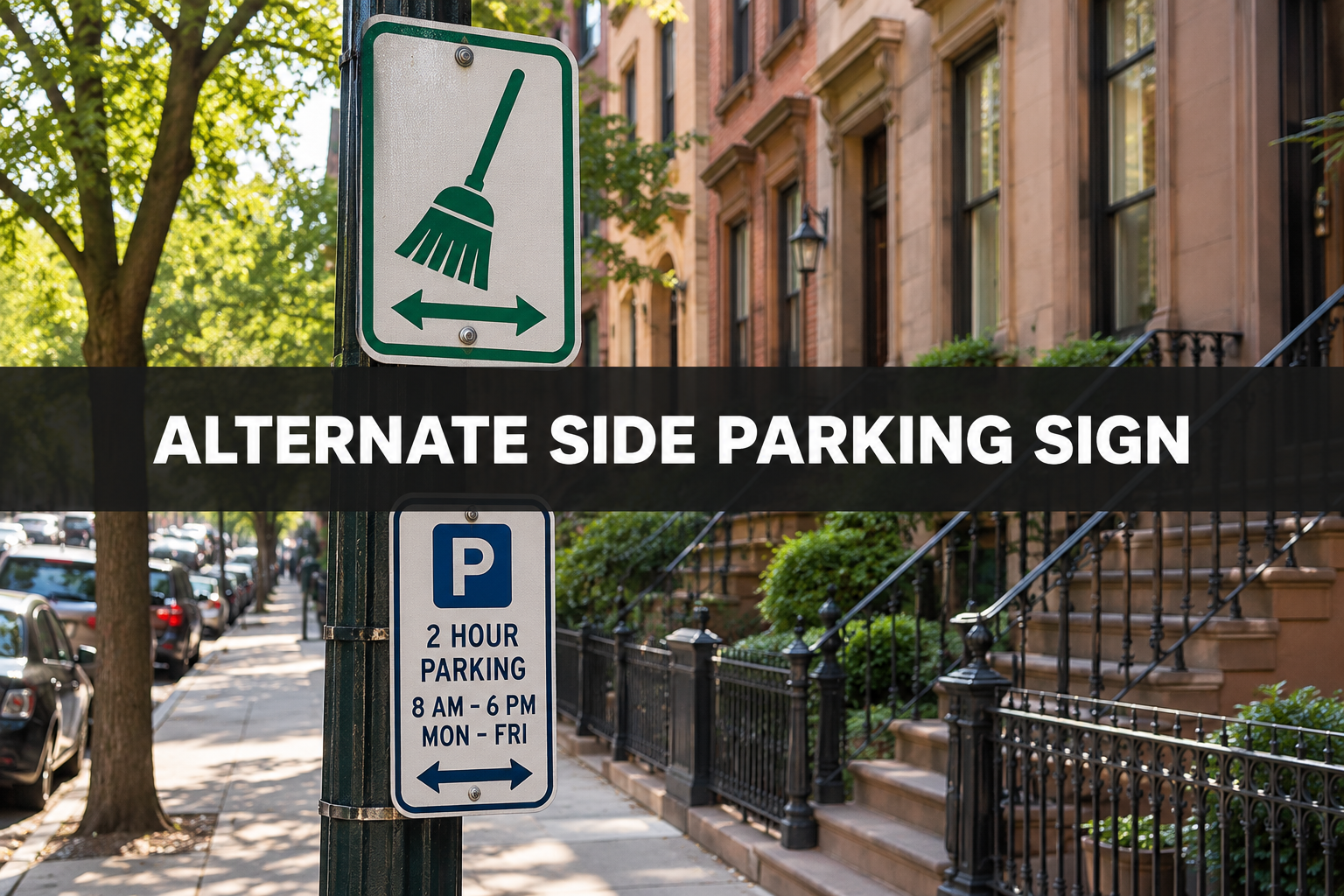
The key visual cue is the broom icon, usually paired with the words «No Parking» and a specific day/time range. This is legally distinct from a generic «No Parking» sign without a broom symbol, which may apply for different reasons (loading zones, commercial vehicle restrictions, etc.) and follow different hours. If you do not see the broom, you are not looking at an ASP sign at all.
Decoding the Broom Symbol and Text
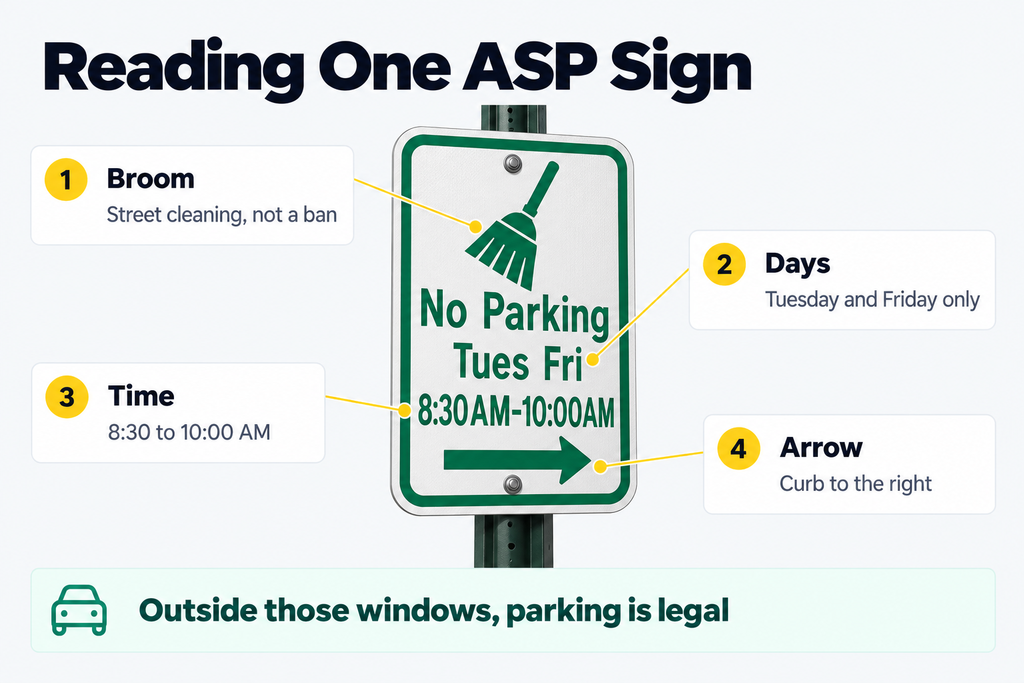
A standard alternate side parking sign includes:
- The broom icon, confirms this is a street-cleaning rule, not a general parking ban.
- «No Parking» text, the restriction type during the posted window.
- Day(s) of the week, for example, «Mon Thu» meaning Monday and Thursday.
- Time range, for example, «9:00AM, 10:30AM,» showing exactly when the restriction is active.
- Arrows, pointing left, right, or both directions, indicating which section of curb the sign governs. A single sign rarely covers an entire block; arrows mark the boundary where the rule starts or stops.
«If you only remember one thing about alternate side parking signs: the broom means street cleaning, and street cleaning is temporary, not permanent.»
Step-by-Step: How to Read a Typical ASP Sign
Follow this sequence every time you approach a sign:
- Find the broom icon. If present, this is an alternate side parking sign tied to sanitation.
- Identify the days listed. Many residential blocks use two-day patterns (Monday/Thursday or Tuesday/Friday) to split the street into cleaning cycles.
- Read the time window carefully. Standard residential ASP windows often run about 90 minutes, though commercial corridors may have longer or multiple windows.
- Check the arrows. Confirm the sign applies to the stretch of curb where your car is parked, not the adjacent block.
- Look for a second sign on the same pole. Many poles carry a combination of ASP plus meter rules, «No Standing,» or «No Stopping» restrictions.
- Cross-reference the date. Determine whether today is a suspension day (holiday, weather emergency, or declared suspension).
Worked Example 1: Basic ASP Only
Sign reads: Broom symbol, «No Parking,» «Tues Fri,» «8:30AM, 10:00AM,» arrow pointing right.
Interpretation: On Tuesdays and Fridays only, between 8:30 and 10:00 AM, parking is prohibited on the curb to the right of the sign. Outside those two windows, including all day Monday, Wednesday, Thursday, Saturday, and Sunday, and outside the 8:30-10:00 window on Tuesday/Friday, parking is legal here, assuming no other restriction applies.
Worked Example 2: ASP Plus Metered Parking
Sign reads: Top sign, broom symbol, «No Parking, Mon Thu, 11:30AM, 1:00PM.» Bottom sign, «Muni-Meter Parking, 8AM, 7PM except Sunday.»
Interpretation: This spot is metered most of the day, but during the Monday/Thursday street-cleaning window, the ASP rule overrides the meter, you cannot park there even if you pay. Outside that window, normal meter rules and payment apply.
Worked Example 3: ASP Plus No Standing
Sign reads: Top sign, broom symbol, «No Parking, Wed Sat, 9AM, 10:30AM.» Bottom sign, «No Standing Anytime.»
Interpretation: The «No Standing Anytime» sign controls here at all times, including outside the ASP window. The street-cleaning sign is essentially redundant for parking purposes since standing is never allowed regardless of the day. This combination is common near bus stops, fire hydrants, or corners. For a deeper look at the rules, read what «No Standing» means in NYC.
Worked Example 4: ASP Plus No Stopping
Sign reads: Broom symbol, «No Parking, Mon Wed Fri, 8AM, 9AM,» combined with «No Stopping 4PM, 7PM» lower on the pole.
Interpretation: Two separate restricted windows exist on the same curb for different reasons. Mornings are governed by street cleaning; the evening rush-hour window is a no-stopping zone unrelated to sanitation. A driver must track both time blocks independently.
How Holidays and Suspensions Affect an Alternate Side Parking Sign
The printed schedule on an alternate side parking sign assumes a normal business day. It does not automatically apply on:
- Official NYC holidays, the city publishes an annual calendar (updated for 2026) listing which holidays suspend ASP citywide.
- Snow emergencies or weather events, the Department of Sanitation can suspend ASP on short notice when plows need the streets, sometimes with same-day notice.
- Religious observances, ASP is suspended on various designated dates throughout the year.
When ASP is suspended, the broom-symbol sign is paused for that day only, it does not disappear and does not cancel any other sign on the same pole. This is the single most common point of confusion: a driver sees «ASP suspended today» and assumes the whole pole is clear, then gets ticketed under a separate No Standing or metered rule that was never suspended.
Practical rule: When ASP is suspended, read the other sign on the pole. That second sign is still fully active and enforceable. Our complete guide to NYC alternate side parking rules covers the full rulebook.
Past Pilot: Once-a-Week ASP in Prospect Heights
From August 3 to September 25, 2026, the Department of Sanitation tested once-a-week street cleaning on several blocks of Prospect Heights, Brooklyn, between Eastern Parkway and Atlantic Avenue. Drivers only had to move their cars on the second day listed on the sign. DSNY ended the pilot without making it permanent after compliance fell from 73% to 62%, and affected drivers go back to moving their cars twice a week. The lesson is simple: read the sign actually posted on your block, and check the live status for your neighborhood, such as Park Slope or Williamsburg.
Ticket Risk and the Grace Period
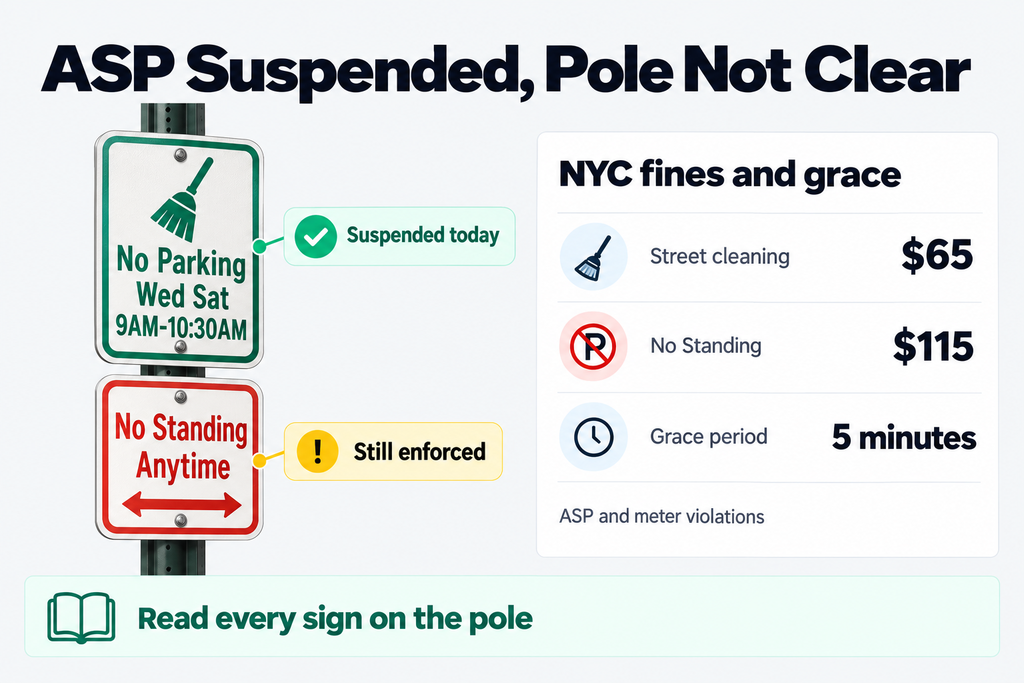
NYC law provides a 5-minute grace period for alternate side parking and parking meter violations. Treat it as a safety margin, not a right you can demand on the spot, and do not rely on it as a parking strategy.
The fine for an alternate side parking (street cleaning) violation is $65 citywide, according to the NYC Department of Finance. A general No Standing violation (code 14) is $115. Always check your actual summons for the exact violation code and amount.
| Violation Type | Common Trigger | Fine (NYC DOF) |
|---|---|---|
| Street cleaning (ASP) | Parked during posted broom-symbol window | $65 |
| No Standing | Parked at any time in a no-standing zone | $115 |
Fine amounts are set by violation code, so confirm the exact figure on your summons. For current penalties and next steps, see our NYC parking ticket fine guide and the walkthrough on how to fight a parking ticket.
How to Double-Check with Official Sources
Because suspensions and holiday schedules change throughout the year, the printed sign alone is not always enough. Before relying solely on the pole:
- Check the NYC Department of Transportation’s official sign legend and street parking map for your exact block.
- Review the Department of Sanitation’s current-year ASP holiday suspension calendar.
- Confirm there is no active weather-related suspension announced for that day.
- When in doubt, verify real-time status rather than guessing from memory.
Check Live ASP Status Before You Park
Reading a sign correctly is only half the battle, knowing whether today’s rules are even active is the other half. For real-time alternate side parking status across New York City neighborhoods, visit the live NYC alternate side parking status page before you leave your car for the day.
Conclusion
An alternate side parking sign is a layered piece of information: a broom icon signaling street cleaning, specific days and times, directional arrows, and often a second sign governing standing, stopping, or meter rules. Misreading any single element, or assuming a suspension clears the entire pole, is how avoidable tickets happen. The safest approach is methodical: identify the broom, confirm the days and times, check the arrows, read every sign on the pole, and verify today’s suspension status before you walk away. When schedules shift due to holidays or weather, a quick check of live, current-day status takes the guesswork out of parking in New York City. Browse more ASP guides or find a garage on our NYC parking directory when you would rather skip street cleaning altogether.