A single missed meter payment in New York City can cost more than an entire day of parking would have in the first place. With fines of $35 to $65 per expired-meter violation, understanding meter parking NYC rules is not just convenient; it is financially necessary.
Meter parking NYC rates, time limits, and payment methods have shifted significantly in recent years as the city moves toward pay-by-plate technology and app-based payment through ParkNYC. Drivers who still expect the old pay-and-display slip or coin-fed meters may be surprised to find a different system waiting at the curb. This guide breaks down exactly how meter parking NYC works today, what you will pay by zone, when meters are not in effect, and how to avoid an unnecessary ticket.
Key Takeaways
- Meter parking NYC rates are set by zone (M1, M2, M3, Zone 1, Zone 2, Zone 3), with hourly prices ranging from $1.50 to $9.00 depending on location and time parked.
- Meters are not in effect on Sundays and on six major holidays: New Year’s Day, Memorial Day, Independence Day, Labor Day, Thanksgiving, and Christmas.
- The city is phasing out pay-and-display Muni-Meters in favor of pay-by-plate meters and the ParkNYC app, which lets drivers pay, extend time remotely, and manage multiple vehicles.
- Overpaying or being overcharged has become a real issue tied to app settings and meter configuration errors, so drivers should double-check the zone and rate posted on-site before paying.
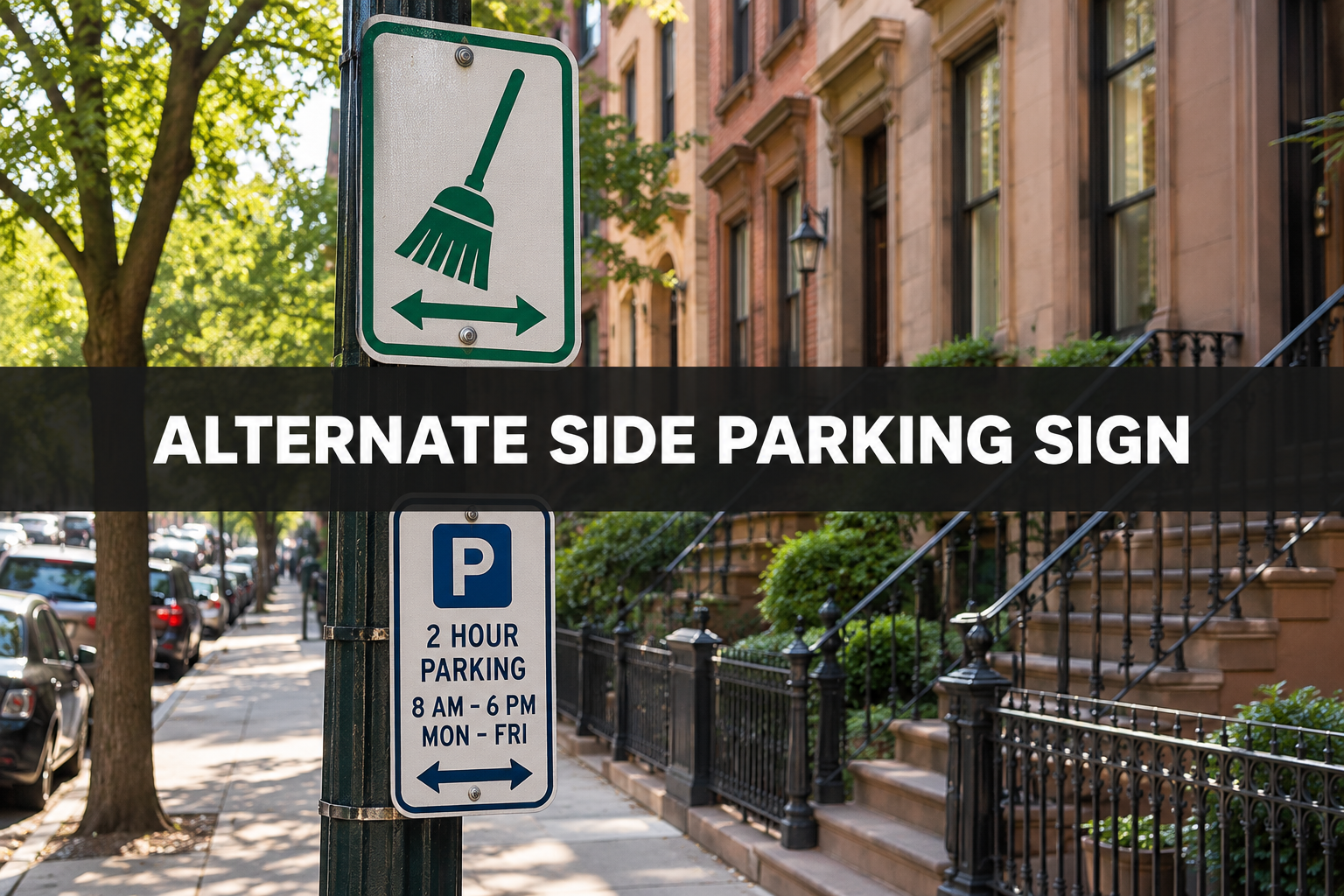
- Always verify current alternate side parking status before leaving your car, since ASP and meter rules operate independently of each other.
How NYC Parking Meters and Muni-Meters Work
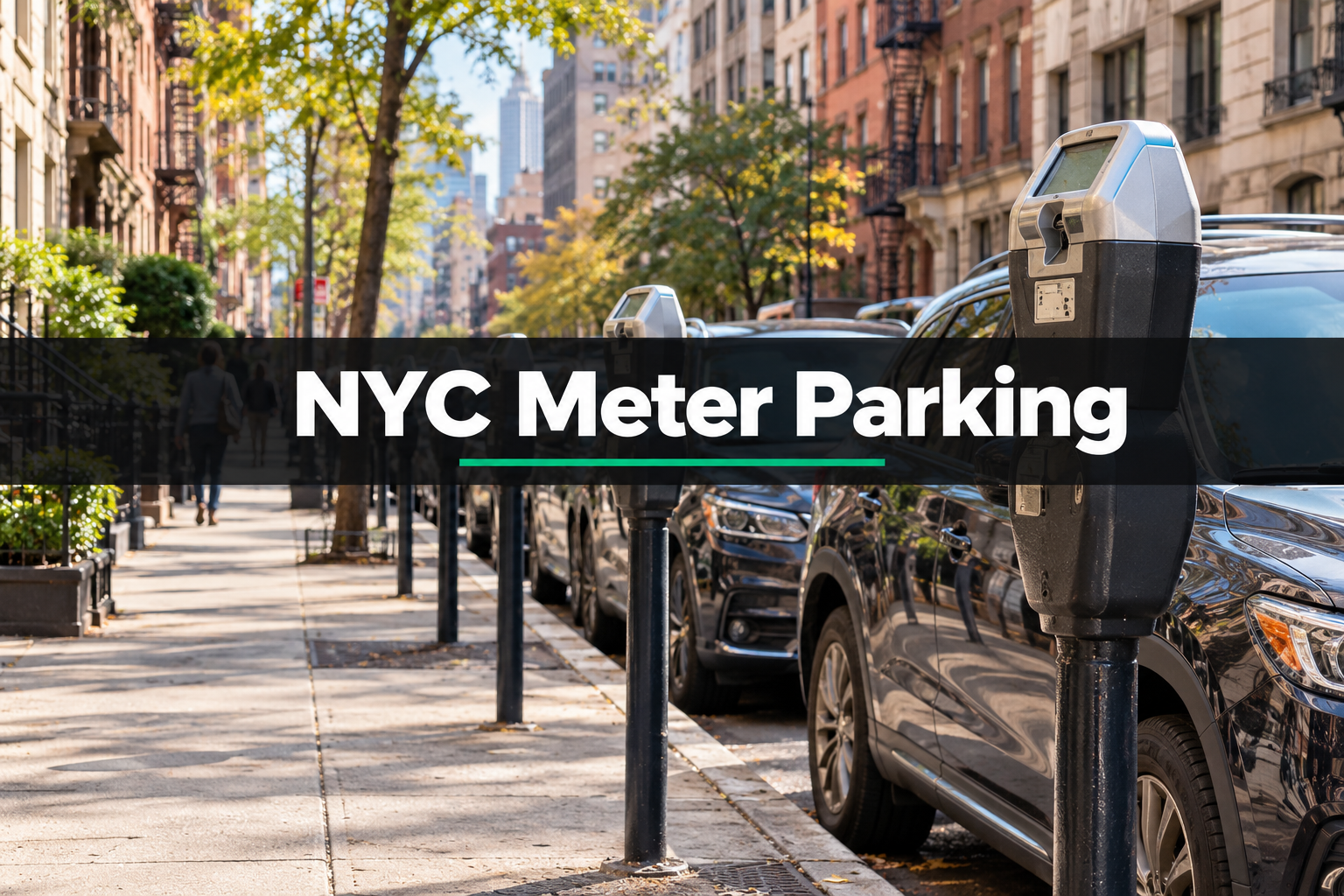
Metered parking in New York City is regulated through signage, posted zones, and either a physical meter or a mobile app. Historically, most blocks used Muni-Meters: solar-powered kiosks that print a paper receipt to place on the dashboard after payment. Drivers would walk to a central meter, pay for a block of time, then return to their vehicle and display the receipt.
That system is being phased out. The city has been converting many Muni-Meters to pay-by-plate meters, which eliminate the paper receipt entirely. Instead, drivers enter their license plate number directly into the meter or into the ParkNYC app, and payment is tied electronically to that plate. Enforcement officers then check the plate against the payment system rather than looking for a receipt on the windshield.
This transition, which has continued through 2026, means drivers should not assume older payment habits still apply. The safest approach is to read the posted sign and meter instructions at each specific location, since conversion has not happened uniformly across every block.
Meter Parking NYC Rates by Zone
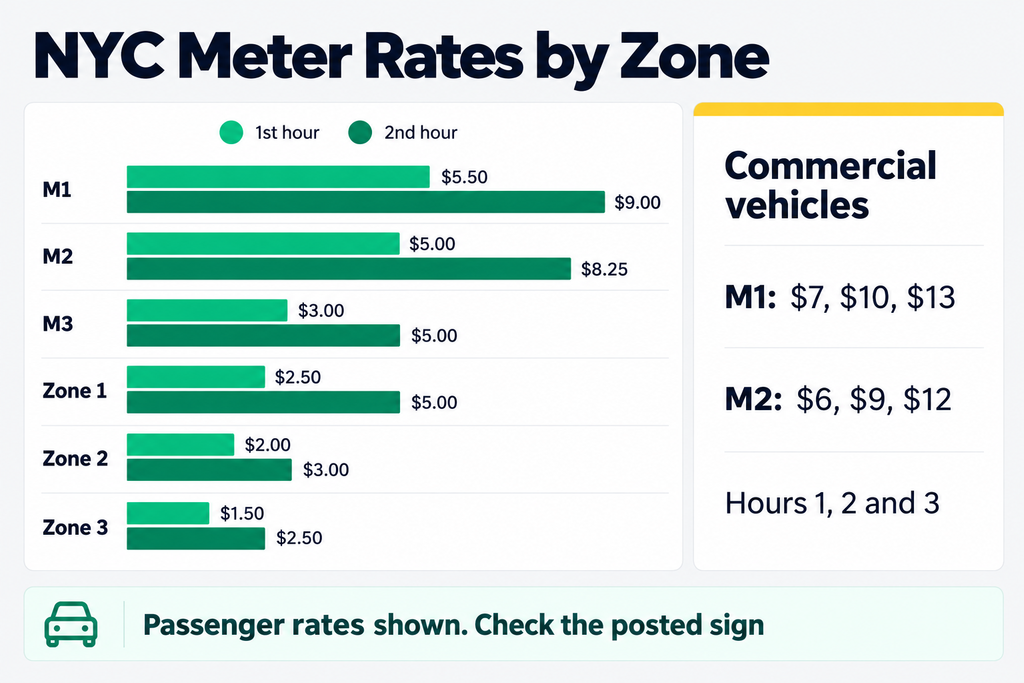
New York City’s Department of Transportation sets meter rates based on commercial zones, with higher rates in busier Manhattan districts and lower rates in less congested areas. Rates typically increase after the first hour, encouraging turnover in high-demand spots.
The verified official rate structure, based on nyc.gov/parking, breaks down as follows:
| Zone | 1st Hour | 2nd Hour |
|---|---|---|
| M1 | $5.50 | $9.00 |
| M2 | $5.00 | $8.25 |
| M3 | $3.00 | $5.00 |
| Zone 1 | $2.50 | $5.00 |
| Zone 2 | $2.00 | $3.00 |
| Zone 3 | $1.50 | $2.50 |
These zone designations are posted on nearby signage or displayed on the meter or app interface itself. Drivers should never guess the rate; the correct zone is always identified at the specific location where the vehicle is parked. Commercial vehicles pay more, but only in zones M1 and M2: $7, $10 and $13 for the first, second and third hour in M1, and $6, $9 and $12 in M2.
«The zone posted on the sign, not the neighborhood name, determines what you actually pay.»
Time Limits for Meter Parking NYC
Time limits vary by location and are tied to the same signage that indicates the rate zone and meter hours. Common limits include one-hour, two-hour, and all-day metered parking, depending on the block’s designated use. Commercial corridors and high-traffic shopping areas tend to have shorter maximum stay windows to keep spaces turning over, while residential-adjacent metered blocks may allow longer stays. Metered curbs are also subject to other restrictions, so see what «no standing» means in NYC and compare nearby options in the NYC parking garage directory if the posted limit is too short.
Meter hours, meaning the specific days and times when payment is required, are also posted on the sign. Outside of those hours, parking may be free even if the meter or app shows an active rate option. It is important to read the full sign, not just the meter screen, because signage takes precedence over assumptions about standard hours.
When Meters Are Not in Effect
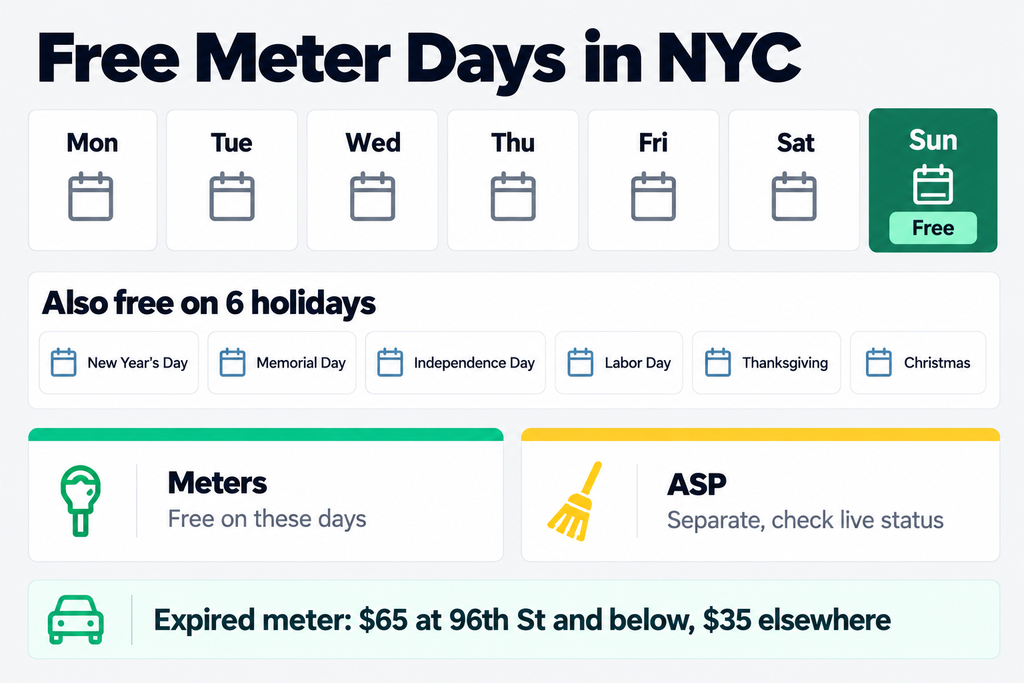
Meter parking NYC rules include built-in exceptions. Payment is not required on:
- Sundays, citywide
- New Year’s Day
- Memorial Day
- Independence Day
- Labor Day
- Thanksgiving
- Christmas
On these days, metered spaces are generally free unless posted signage states otherwise for a specific block. Drivers should still check for construction notices, special event restrictions, or temporary signage that could override the standard holiday exemption. Also note that meter exemptions are separate from alternate side parking (ASP) suspensions. A day without meter payment requirements does not automatically mean street cleaning rules are also suspended.
Paying With ParkNYC: How It Works
ParkNYC is the city’s official mobile app for meter parking NYC payments and is directly integrated with the pay-by-plate meter network. Rather than carrying coins or returning to a Muni-Meter kiosk, drivers can start and manage a parking session from their phone.
Setting Up and Using ParkNYC
- Download the ParkNYC app and create an account.
- Add a payment method and register one or more license plates.
- At the parking spot, select the correct zone number (posted on signage or the meter).
- Start the session and confirm the rate matches the posted price.
- Extend the session remotely if needed, as long as the maximum time limit for that zone has not been reached.
- End the session early if leaving before time expires; unused time is not refunded in most cases, so avoid overpaying initially.
ParkNYC charges standard users a small convenience fee on top of the meter rate, which is common for app-based municipal payment systems. Business and fleet users have access to additional payment channels and account management tools designed for multiple vehicles, useful for companies with delivery or service fleets that park frequently on metered blocks. Comparing apps? See our roundup of the best parking apps in NYC.
Pay-by-Plate Meter vs. Paying at the Meter Kiosk
Both options remain available on many blocks during the transition period, but they are not interchangeable:
- ParkNYC app: Pay by plate remotely, extend time without returning to the car, manage multiple vehicles, incurs a small service fee.
- Meter kiosk: Pay by plate directly at the machine using coins, credit card, or the kiosk interface, no app required, but extending time means physically returning to the kiosk.
Both methods feed into the same enforcement system when the meter has been converted to pay-by-plate. Drivers should confirm which system is active at their specific location, since older coin-and-receipt Muni-Meters may still be in operation on some blocks as the citywide conversion continues through 2026.
What Happens If the Meter Expires
An expired meter is one of the most common parking violations issued in New York City. Enforcement agents check plates against the payment system or look for an expired paper receipt, depending on the meter type at that location. If no active payment is found, a violation is issued on the spot. Under the NYC Finance fine schedule in effect as of 9/22/2026, an expired meter (violation code 37) carries a $65 fine in Manhattan at 96th Street and below and $35 everywhere else. See how much a parking ticket costs in NYC, and if you get one, follow our guide to fighting an NYC parking ticket or browse Tickets & Disputes.
Fines vary by violation code and location, and there is generally no formal grace period once the posted time has lapsed. Drivers who return even a few minutes late can find a ticket already on the windshield or electronically issued. The best defense is proactive time management:
- Set a phone reminder a few minutes before the session ends.
- Use the ParkNYC app’s remote extension feature instead of risking a walk back to the kiosk.
- Avoid parking longer than the maximum allowed time, even if willing to keep paying, since many zones cap total stay duration regardless of payment.
A Growing Concern: Overcharging and App Errors
App-based payment systems can occasionally show a zone or rate that does not match the posted sign. This underscores an important practical habit: always compare the rate shown in the app or on the kiosk screen against the rate posted on the physical sign before confirming payment. If a discrepancy appears, it is worth documenting the sign, the app screen, and the time before proceeding, in case a dispute becomes necessary later.
This kind of mismatch is not universal, but it is a reminder that automated systems are not infallible. A few seconds of double-checking can prevent either overpaying or, just as importantly, underpaying and risking a ticket.
Meter Parking NYC and Alternate Side Parking: Two Separate Systems
One of the most common sources of confusion is assuming that meter rules and alternate side parking (ASP) rules work together. They do not. A block can have meters in effect while ASP is suspended, or ASP in effect while meters are free on a Sunday. Both systems must be checked independently before leaving a vehicle parked on the street. For the full rules, read the complete guide to alternate side parking in NYC or start from Park Rules Live.
Because ASP suspensions can change due to holidays, weather events, or city announcements, drivers should check current status before relying on memory or assumption.
Conclusion
Meter parking NYC rules have evolved substantially with the shift toward pay-by-plate technology and the ParkNYC app, but the fundamentals remain consistent: know your zone, know your rate, know your time limit, and know your exemption days. Passenger-vehicle rates range from $1.50 to $9.00 depending on zone and hour, meters are suspended on Sundays and six major holidays, and payment can be made either at a kiosk or remotely through ParkNYC. Expired meters remain one of the most frequent and avoidable violations in the city, so proactive monitoring, whether through a phone reminder or the app’s extension feature, is the simplest way to avoid a fine.
Before parking on any metered block, take a moment to confirm posted signage matches what the meter or app displays. Then, since meters and alternate side parking operate independently, check the live ASP status page to confirm street cleaning rules for that day before walking away from the car.
This article is for informational purposes only and does not constitute legal or financial advice.